- Corporate Governance Charter
- Board Composition
- Board Operations
- Board Remuneration and Evaluation
- Enhancement of Shareholder Value
- Strengthening Shareholder Rights and Communication
Governance
Corporate Governance Charter
Aligned with prevailing efforts to enhance corporate governance and reinforce the protection of shareholder rights, Coway has adopted a Corporate Governance Charter that codifies the fundamental principles and standards underlying a sound and transparent governance framework. Serving as an internal and external pledge to continuously strengthen corporate governance, this Charter establishes an institutional foundation for protecting shareholder rights and practicing board-centered responsible management. Through the enactment of this Charter, Coway demonstrates its voluntary commitment to governance reform and reinforces a transparent, board-led decision-making system, thereby consolidating trust across capital markets and stakeholders.
Board Composition
Coway's Board of Directors operates in accordance with applicable laws and the company's Articles of Incorporation. Shareholders entrust the Board with the highest decision-making authority over corporate management. The Board is committed to establishing a sound governance framework based on checks and balances. As of the end of April 2026, the Board comprises three executive directors and six independent directors. By maintaining an independent director ratio of 66.7%—substantially exceeding statutory requirements—Coway has bolstered board independence and transparency, enabling effective oversight and check-and-balance functions over executive management.
Furthermore, to secure board diversity and expertise, three of the six independent directors (50%) are female. This is the result of proactive efforts not only to fully comply with relevant regulations, but also to build a flexible and balanced governance framework by integrating diverse perspectives into key management decision-making. Moving forward, the Coway Board of Directors will continue to advance its functions of deliberating and resolving core business matters and managing operational risks, striving to enhance corporate transparency and solidify the foundation for sustainable growth.
Board Composition
(As of the end of April 2026)
| Category | Name | Gender | Position | Professional experience | Date of initial appointment |
|---|---|---|---|---|---|
| Executive directors | Jun Hyuk Bang | Male | Chairperson of the Board |
|
Feb. 7, 2020 (Reappointed twice) |
| Jang Won Seo | Male | CEO |
|
Feb. 7, 2020 (Reappointed twice) |
|
| Soon Tae Kim | Male | CFO |
|
Mar. 29, 2023 (Reappointed once) |
|
| Independent directors | Gil Yeon Lee | Female |
|
|
Mar. 31, 2022 (Reappointed once) |
| Jung Ho Kim | Male |
|
|
Mar. 31, 2025 | |
| Tae Hong Kim | Male |
|
|
Mar. 31, 2025 | |
| Si Moon Jeon | Male |
|
|
Mar. 31, 2026 | |
| Catherine Heyjung Sonu | Female |
|
|
Mar. 31, 2026 | |
| Hee Sun Chung | Female |
|
|
Mar. 31, 2026 |
Board Independence
Coway ensures the Board of Directors' autonomous decision-making and establishes sound governance through a system of checks and balances centered on independent directors. To secure their independence, Coway has established its own Independence Guidelines reflecting relevant laws and global standards, based on which the Board and the Independent Director Recommendation Committee review the independence of both candidates and incumbent directors. Transparent, fair procedures and systematic screening are applied from the nomination stage to strengthen independence. Furthermore, pursuant to Article 12 of the Board Regulations, Coway maintains a framework allowing the Board to solicit opinions from relevant executives, employees, or external experts and invite advisors to attend as observers—ensuring that independent directors can express objective, professional viewpoints.
To further strengthen the Board's independence and check-and-balance function, Coway introduced the Lead Independent Director system in April 2026. The Lead Independent Director represents all independent directors and is authorized to convene and chair separate meetings composed exclusively of independent directors. The Lead Independent Director may also request reports and materials on key issues from management, serving as a bridge for seamless communication between management, the Board, and shareholders. This framework substantively complements Coway's structure in which an executive director also serves as Board Chairperson, reinforcing board-centered responsible management.
Board Diversity
Coway is committed to securing diversity within the Board of Directors to enable rational decision-making from multiple perspectives. The Articles of Incorporation explicitly stipulate the diversity principle that "the Board shall not be composed entirely of directors of a single gender." By appointing three women among the six independent directors, Coway has achieved a female independent director ratio of 50%, exceeding statutory requirements. Furthermore, Coway promotes nationality diversification by incorporating non-Korean independent directors, while expanding the age distribution across the Board to achieve generational balance and harmony. By establishing a Board that encompasses diversity in gender, nationality, and age, Coway elevates decision-making quality and ensures that each director's distinct expertise creates powerful synergies on this foundation of diversity.
Board Expertise and Competencies
To respond agilely to the rapidly changing global business environment, Coway has adopted and operates the Board Skills Matrix (BSM) to systematically strengthen the expertise of the Board of Directors. The BSM serves as a tool for objectively evaluating and managing the competency composition of directors, playing a key role in securing expertise optimized for Coway's mid- to long-term strategic direction.
Coway's directors possess extensive expertise across various areas of corporate management, including leadership, management and strategy, finance and accounting, legal affairs, ESG, M&A, R&D and technology, global industries, and capital and financial markets. Based on the BSM, Coway maintains a balanced expertise that is not overly concentrated in any single area. When appointing independent directors, Coway also leverages the results of competency analysis to prioritize areas of expertise that require reinforcement, thereby identifying optimal candidates.
Following director appointments, Coway actively supports independent directors in fulfilling their fiduciary duties. Dedicated support—including key operational data and briefing materials—is provided by specialized units such as the IR Team, Audit Support Team, Management Office, Finance Office, and Internal Accounting Management Team. Coway also continuously runs internal and external training programs for independent directors.
Board Skills Matrix
(As of the end of April 2026)
Board Skills Matrix
(As of the end of April 2026)
| Category | Executive directors (3) | Independent directors (6) | |||||||
|---|---|---|---|---|---|---|---|---|---|
| Name | Jun Hyuk Bang | Jang Won Seo | Soon Tae Kim | Gil Yeon Lee | Jung Ho Kim | Tae Hong Kim | Si Moon Jeon | Catherine Heyjung Sonu | Hee Sun Chung |
| Gender | Male | Male | Male | Female | Male | Male | Male | Female | Female |
| Age | 50s | 50s | 50s | 50s | 60s | 50s | 60s | 40s | 40s |
| Nationality | Republic of Korea | Republic of Korea | Republic of Korea | Republic of Korea | Republic of Korea | Republic of Korea | Republic of Korea | Republic of Korea | Republic of Korea |
| Leadership | ● | ● | ● | ● | ● | ● | |||
| Management/ Strategy |
● | ● | ● | ● | |||||
| Finance/ Accounting |
● | ● | ● | ● | |||||
| Legal | ● | ● | |||||||
| ESG | ● | ● | ● | ||||||
| M&A | ● | ● | |||||||
| R&D/ Technology |
● | ● | |||||||
| Global Industries | ● | ● | |||||||
| Financial/ Capital Markets |
● | ||||||||
Director Appointment Process
All Coway directors are appointed by resolution of the General Meeting of Shareholders. For executive directors, Coway broadly identifies and develops both internal talent and external experts, with appointments finalized upon shareholder approval. The CEO is appointed in accordance with the 「CEO Succession Policy」, which clearly sets forth the required qualification criteria. Coway maintains a continuously updated pool of executive leadership candidates by sourcing internal and external candidates in a balanced manner, and the CEO is ultimately appointed by Board resolution from among the executive directors elected at the General Meeting of Shareholders.
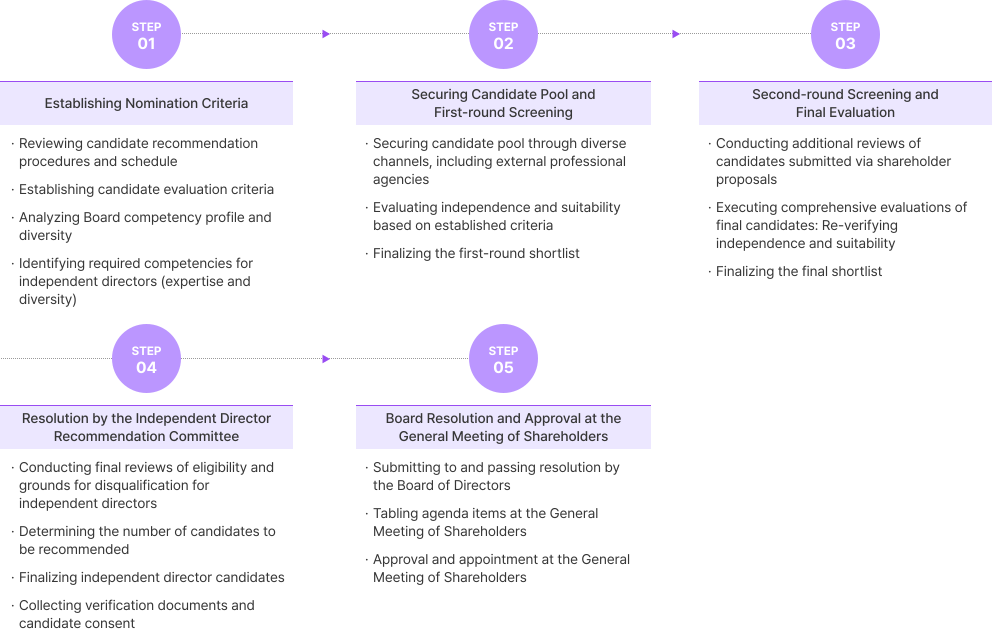
The appointment of independent directors follows a transparent and fair procedure. The Independent Director Recommendation Committee, composed entirely of Independent Directors, identifies the required competencies in advance based on the Board Skills Matrix (BSM). Based on these competencies, Coway secures a broad candidate pool through diverse channels, including recommendations from external professional agencies and shareholder proposals. The screening process comprehensively assesses eligibility, adherence to independence guidelines, expertise, and suitability. Detailed evaluation criteria include the candidate's potential to enhance corporate value, contribution to Board diversity, independence and fairness, ethical integrity, commitment to fiduciary duty, and professional expertise. In the final stage, eligibility requirements and potential grounds for disqualification are meticulously reviewed to confirm candidates possessing both high expertise and strict independence. Through these systematic procedures, Coway upholds a fair and credible director appointment process.
Independent Director Appointment Process
Board Operations
Committees under the Board
To maximize the efficiency and expertise of Board operations, Coway has established the Audit Committee, Management Committee, Independent Director Recommendation Committee, ESG Committee, Compensation Committee, and Related Party Transactions Committee under the Board. Each committee strictly complies with the composition requirements under relevant laws such as the Commercial Act and maintains an independent decision-making framework based on Article 42 of Coway's Articles of Incorporation and the codified operating regulations approved by the Board.
Establishment of the Compensation Committee
To enhance the fairness and transparency of executive compensation decisions, Coway established the Compensation Committee in May 2025. Comprising three independent directors to ensure independence and objectivity, the Committee independently deliberates on executive director remuneration, executive incentive budgets, and executive compensation systems. Through the Committee, Coway strengthens governance over executive compensation and pursues long-term corporate value enhancement based on the trust of the market and stakeholders.
Establishment of the Related Party Transactions Committee
In March 2026, Coway established the Related Party Transactions Committee to objectively oversee the fairness of transactions among affiliated entities and reinforce management transparency. To prioritize independence and objectivity in deliberations, the committee is composed entirely of independent directors and serves as a core internal control body that practices board-centered responsible management.
The Related Party Transactions Committee pre-reviews intra-group transactions pursuant to relevant laws, including the Commercial Act and the Monopoly Regulation and Fair Trade Act. Agenda items rejected by the committee are strictly barred from being submitted to the Board, a rigorous process that strengthens Coway's internal control functions and ensures a transparent transaction order. Going forward, Coway will continue to enhance governance credibility and solidify an advanced corporate governance framework through the Committee.
Audit Committee Support Organization
To support the Audit Committee's independent and efficient audit activities, Coway operates the Audit Support Team as a direct organization under the Board, ensuring independence from management, with additional support from the IR, Finance, and Internal Accounting Management Teams as needed. The Audit Support Team assists with agenda preparation and meeting management, while the Finance Team handles external audit matters and the Internal Accounting Management Team handles Internal Accounting Control System operations, thereby supporting the Audit Committee in fulfilling its duties.
Committees under the Board
(As of the end of April 2026)
| Committee | Purpose of Establishment | Key Responsibilities | Members (*Chairperson) |
|---|---|---|---|
| Management Committee | Promptly deliberating on and resolving matters related to Coway's management |
|
|
| Independent Director Recommendation Committee¹⁾ | Ensuring fairness in the process of nominating and appointing independent directors |
|
|
| Audit Committee | Auditing Coway's accounting and operations |
|
|
| ESG Committee | Supervising mid- to long-term ESG strategies, policies, and key matters to enhance long-term corporate value and pursue sustainable growth |
|
|
| Compensation Committee | Responsible for managing a fair and transparent compensation system |
|
|
| Related Party Transactions Committe | Enhancing the fairness and transparency of transactions among affiliated companies |
|
|
1) Chairperson scheduled to be appointed
2025 Board Operations
- Number of Board meetings held 7 times
- Total agenda items 33 items
- Resolution Items 22 items
- Reporting items 11 items
- Board meeting attendance rate 100%
2025 Operations of Committees under the Board
- Management Committee 8 times
- Independent Director Recommendation Committee 4 times
- Audit Committee 5 times
- ESG Committee 2 times
- Compensation Committee 1 time
-
Related Party
Transactions
Committee -¹⁾
1) Newly established in 2026; no meetings were held in 2025
Board Remuneration and Evaluation
Performance Evaluation and Remuneration of Independent Directors
Coway appoints highly qualified independent directors and determines reasonable compensation by comprehensively reviewing the level of legal responsibilities and compensation practices in the same industry. To ensure the independence of Independent Directors' activities, the evaluation of Independent Directors is not directly linked to compensation. Considering that linking compensation to evaluation could undermine independent judgment, Coway institutionally safeguards the independence and fairness of Independent Directors by clearly separating the two elements.
Performance Evaluation of CEO and Executives
Coway designs the compensation structure for its CEO and executives by separating short-term and mid- to long-term performance, thereby fostering an environment in which management can make responsible decisions. To this end, Short-Term Incentives (STI) incorporate comprehensive Key Performance Indicators (KPIs) and competency evaluations, while Long-Term Incentives (LTI) are balanced to align with executives' cumulative mid- to long-term capabilities and role-based contributions. Through this approach, Coway operates an executive compensation framework designed to drive sustainable corporate value creation.
Introduction of the Restricted Stock Unit (RSU) Program
To closely align the interests of management with those of shareholders and to enhance corporate value, Coway has introduced and operates a Restricted Stock Unit (RSU) program for key executives starting in 2026. The program is structured into two independent forms based on the purpose and nature of the compensation, driving substantive accountable management.
Board Remuneration
Director remuneration is determined annually within the limit approved at the General Meeting of Shareholders, reflecting each director's responsibilities and performance. Overall remuneration details are disclosed to stakeholders through the annual business report.
Remuneration Paid to Directors
(Unit: KRW 1,000)
| Category | Number of directors | Total remuneration | Average remuneration per person1¹⁾ |
|---|---|---|---|
| Registered director (excluding independent directors and members of Audit Committee) |
3 | 3,425,111 | 1,141,704 |
| Independent director (excluding members of Audit Committee) |
2 (Kyu Ho Kim, Jung Ho Kim) |
91,677 | 45,839 |
| Members of Audit Committee |
4 (Jin Bae Kim (chairperson), Bu Hyun Yoon (member), Gil Yeon Lee (member), Tae Hong Kim (member)) |
194,896 | 48,724 |
1) The average remuneration per person is a simple average calculated by dividing the total remuneration by the total number of directors as of December 31, 2025, which may differ from the actual average remuneration per person
Enhancement of Shareholder Value
Shareholder Composition
As of the end of 2025, Coway's total issued shares amount to 71,909,133 shares, consisting entirely of common stock with no preferred shares. Coway adheres to the "one share, one vote" principle, granting equal voting rights to all shares, and does not adopt a dual-class share system. The 1,141,707 treasury shares held by Coway are restricted from exercising voting rights under the Commercial Act, bringing the number of shares with voting rights to 70,767,426 shares, or 98.4% of the total. These treasury shares were fully retired in February 2026 to enhance shareholder value.
Shares Held by Major Shareholders
(As of the end of 2025)
| Category | Shareholder name | Shares held | Shareholding ratio | |
|---|---|---|---|---|
| Shares with voting rights | Largest Shareholder | Netmarble Corp. | 18,511,446 | 25.7% |
| Related parties | Executives | 17,096 | 0.0% | |
| Foreigners | 40,056,178 | 55.7% | ||
| National Pension Service | 5,152,383 | 7.2% | ||
| Others | 7,030,323 | 9.8% | ||
| Total | 70,767,426 | 98.4% | ||
| Shares without voting rights | Treasury stock | 1,141,707 | 1.6% | |
| Total shares issued | Total | 71,909,133 | 100.0% | |
Shareholder Returns
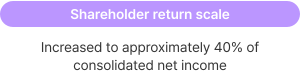
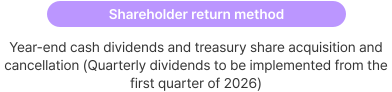
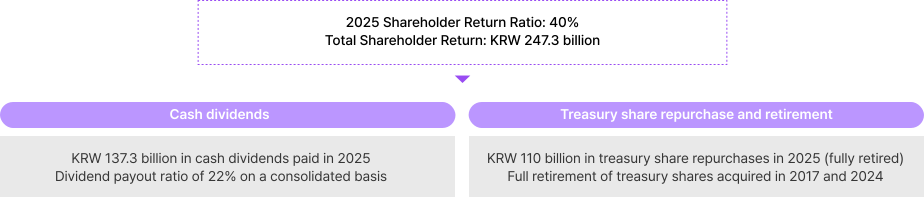
In 2025, Coway established a shareholder return plan covering fiscal years 2025 through 2027. It disclosed the status of the 2025 corporate value enhancement plan on February 6, 2026. In 2025, Coway achieved a shareholder return ratio of 40%, with cash dividends and treasury share repurchases split evenly at approximately 5:5, thereby maximizing shareholder value. Coway has gradually expanded shareholder returns by doubling the return ratio compared to the previous three-year policy. The total amount of shareholder returns has grown steadily in line with rising earnings. Coway also retired approximately 1.9 million previously held treasury shares in full during 2025, effectively enhancing per-share value.
Three-Year Shareholder Return Plan (FY2025-FY2027)
Status of 2025 Shareholder Return Target Achievement
Future Shareholder Return Plan
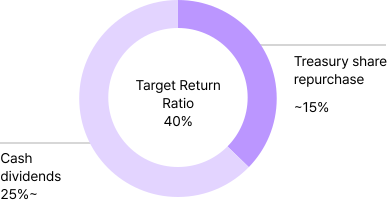
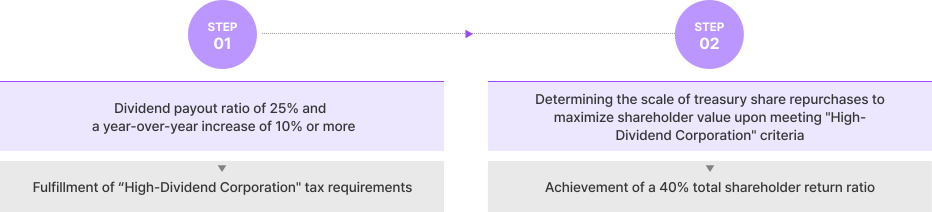
To enhance sustainable shareholder value, Coway plans to actively implement shareholder returns within shareholder return ratio of 40% through 2027. To enable shareholders to benefit from the separate taxation of dividend income, Coway will first allocate 25% as cash dividends to satisfy "High-Dividend Corporation" tax qualification requirements, and will determine the scale of treasury share buybacks for the remaining funds in a manner that maximizes shareholder value.
For 2026, to further enhance the visibility of shareholder returns, Coway plans to distribute the entire remaining funds as cash dividends, excluding the treasury shares acquired between February and April. Furthermore, by initiating quarterly dividends starting in Q1 2026, Coway is establishing a regular quarterly return framework to strengthen the ongoing income structure for its shareholders.
Going forward, Coway remains committed to enabling investors to achieve a stable and high Total Shareholder Return (TSR) through predictable shareholder returns that maximize tangible shareholder benefits.
-
2025 Shareholder Return
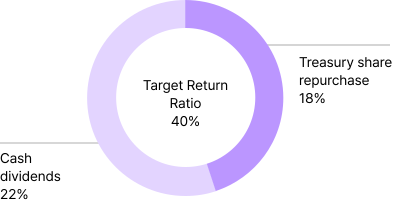
-
Shareholder Return Plan from 2026 Onward
Shareholder Return Plan Reflecting Separate Taxation Requirements for Dividend Income
Strengthening Shareholder Rights and Communication
Support for Shareholders' Exercise of Voting Rights
To enable shareholders to thoroughly review agenda items, Coway issued the convocation notice for the 37th Annual General Meeting five weeks in advance through the Data Analysis, Retrieval and Transfer System (DART) and its website—well beyond the statutory two-week requirement—and provided reference materials in both Korean and English to help domestic and international investors understand the agenda. Additionally, to expand shareholder participation, Coway actively implemented the "Voluntary Compliance Program for Dispersed General Meetings" by scheduling its AGM outside peak concentration dates. Coway also applied the Proxy Voting Solicitation System for all shareholders, supporting the smooth exercise of voting rights through proxy and laying a foundation for shareholders to exercise their legitimate rights.
Protection of Shareholder Rights and Interests
Reflecting the intent of the amended Commercial Act, Coway has built a foundation for protecting shareholder rights. To ensure directors faithfully perform their duties for Coway and its shareholders, the "Director's Duty of Loyalty to Shareholders" has been stipulated in the Articles of Incorporation. Coway also proactively reflected the expanded separate election of Audit Committee members in its Articles of Incorporation, completing the separate election of two members at the March 2026 AGM. These measures strengthen the Audit Committee's independent oversight and establish an institutional foundation to protect minority shareholders' rights in decision-making.
Enhancing Shareholder Convenience
In line with the amended Commercial Act, Coway laid the groundwork for electronic shareholder meetings by amending its Articles of Incorporation at the March 2026 AGM, and plans to hold such meetings with real-time online participation from the 2027 AGM. Coway will also introduce an electronic voting system to further improve accessibility for exercising shareholder rights. Through these initiatives, Coway is fostering an open environment where shareholders can exercise their rights and participate without time or location constraints.
Strengthening Market Communication
Coway has strengthened market communication through executive participation and diversified channels. From the first quarter of 2026, Coway introduced C-Level-led online earnings releases to improve accessibility for global investors. By regularizing executive-led global Non-Deal Roadshows (NDRs), Coway focuses on enhancing shareholder value and securing market trust, and plans to continue identifying potential investors by strategically strengthening IR activities in new regions. Coway is also expanding disclosure of key indicators for investment decisions, ensuring information transparency and improving market predictability.