Risk Management
Risk Management Governance
Risk Management Organization
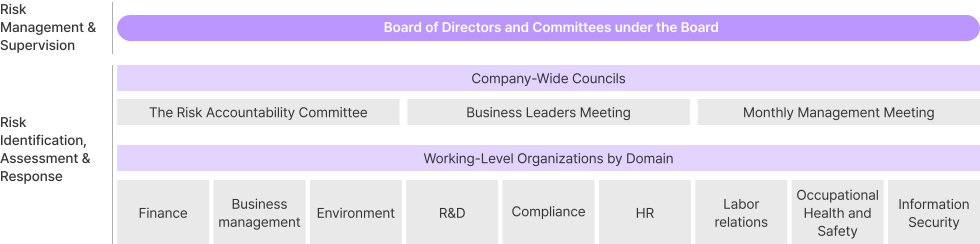
To proactively respond to changes and uncertainties in the business environment, Coway has established a comprehensive risk governance structure that integrates financial and non-financial risk management. Depending on the risk category and impact severity, the Board of Directors, executive management, operational working-level units, and audit bodies execute clearly defined roles, maximizing enterprise-wide crisis response capabilities.
Board of Directors
As the highest decision-making body for Coway's risk management, the Board of Directors reviews and approves company-wide management strategies and key risk response measures. Under the Board, the Management Committee, Audit Committee, Related Party Transactions Committee, and ESG Committee have been established to address risks in their respective areas in a specialized manner. Each committee receives reports on key risk issues identified by working-level organizations, evaluates the appropriateness of response strategies, and provides directions for improvement when necessary.
Management
The Risk Accountability Committee, reporting directly to the CEO, operates under Management Committee oversight. It categorizes risks by type and impact level while setting key mitigation roadmaps. Executive councils, including the Business Leaders Meeting and Monthly Management Meeting, continuously monitor field risks and drive rapid cross-functional crisis intervention.
Working-Level Organizations
Working-level organizations in each risk management area directly identify and assess risks that may arise in the course of business operations. Personnel in each business division manage operational, quality, safety, and other risks specific to their respective area. Working-level organizations conduct periodic risk reviews and set priorities through impact analysis. Identified risks are reported to the Risk Accountability Committee through the Business Leaders Meeting and the Monthly Management Meeting, and are escalated to the relevant committees under the Board of Directors when necessary.
Risk Management Framework
Risk Management Process
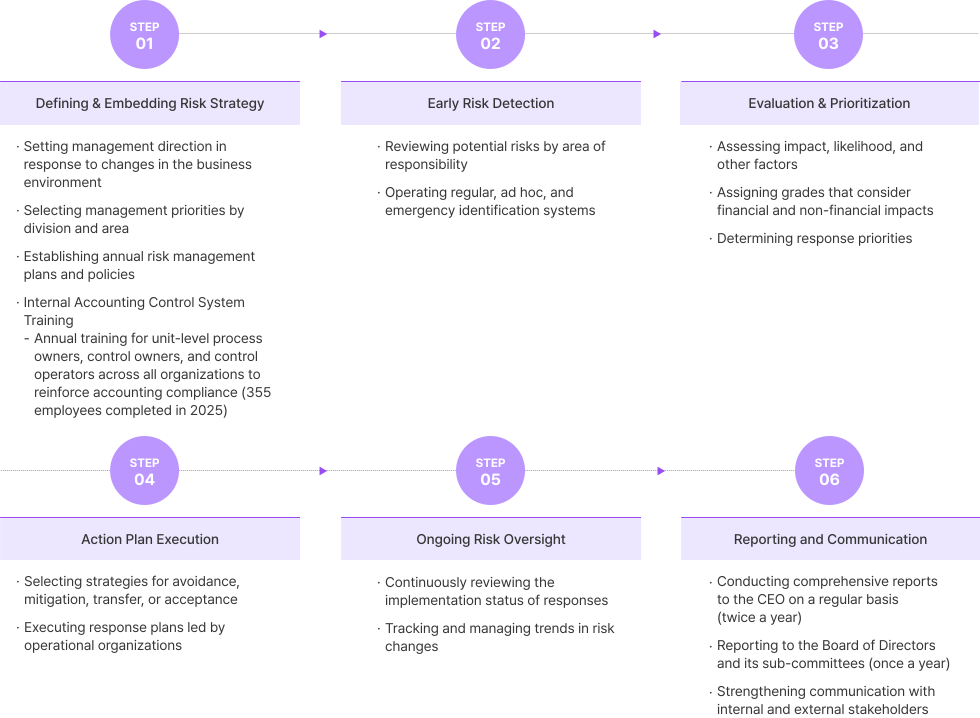
Coway operates an integrated risk management system to proactively identify and respond to key risks that may arise across our business. Dedicated teams in each area, including finance, investment, environment, labor, and information security, identify potential risks at an early stage, assess their likelihood and scope of impact, and develop tailored response measures. Identified risks are discussed from a company-wide perspective through the Business Leaders Meeting and the Monthly Management Meeting. Depending on severity, these risks are escalated to the Audit Committee or the ESG Committee for deliberation. The Board of Directors and its sub-committees regularly review the progress and performance of risk responses, and activate immediate escalation protocols in emergency situations to ensure rapid executive decision-making. We also run parallel feedback and monitoring structures to enhance the effectiveness of our management framework.
Company-wide Risk Management Process
Risk Management Measures by Type
Financial Risks
Financial risks refer to risks that may directly affect Coway's financial performance due to the unpredictability of financial markets and changes in financial structure. These include market risks such as foreign exchange and stock price fluctuations, liquidity risks concerning capital raising and debt-servicing capacity, credit risks stemming from counterparty default, and interest rate risks that escalate financing costs. Unmitigated financial risks can lead to margin compression, restricted cash flows, and weakened balance sheet soundness.
Market Risks
Market risks refer to the uncertainty that the value of financial assets or expected cash flows may change due to price movements in financial markets, including interest rate risks, foreign exchange risks, and other market price risks. Management regularly tracks movements in key financial variables such as interest rates and exchange rates, and analyzes their impact on corporate value. For interest rate risks, we maintain an optimal structure by adjusting the proportion of fixed-rate and floating-rate liabilities, while foreign exchange risks are managed through periodic assessment processes and reporting routines that enable swift responses to changes.

Credit Risks
Credit risks are managed in a centralized manner across the entire enterprise. Beyond counterparty credit exposures arising from accounts receivable or binding contracts, credit risks can manifest across financial assets in general, including cash holdings, cash equivalents, derivative financial instruments, and institution deposits. Coway enforces a strict policy of transacting exclusively with banks and financial institutions maintaining a credit rating of A or higher from recognized credit rating agencies. For counterparties without official credit ratings, we evaluate creditworthiness across multiple dimensions—including financial soundness, historical transaction track record, and industry reputation—and establish credit exposure limits accordingly.
(Based on the Business Report for 2025, Unit: KRW 1,000)

Liquidity Risks
We proactively identify liquidity risks stemming from financial market volatility and model the quantitative impact of shifting funding conditions on our balance sheet, thereby maintaining an agile response framework. To ensure adequate operational liquidity, Coway secures sufficient undrawn credit facilities and tracks cash flow status in real time. Through this disciplined approach, we mitigate risks of financial covenant breaches or line-of-credit limit overruns. Our liquidity forecasting model comprehensively integrates cash flow plans, financial covenant requirements, and internal financial targets, alongside external macro-factors such as foreign exchange control regulations and regional legal constraints.
(Based on the Business Report for 2025, Unit: KRW 1,000)

Capital Risks
To deliver long-term value to our shareholders and investors and reduce funding costs, we maintain an optimal balance in our capital structure. Benchmarking industry peers, Coway manages capital using the debt-to-capital ratio as a key metric, and systematically monitors leverage indicators—including total debt to total capital and equity ratios—to preserve financial stability.
Strategic Risks
Strategic risks are risks associated with changes in the external business environment and corporate strategic decisions, which may adversely affect the achievement of Coway's long-term goals and vision. These include macro-environmental factors such as global economic fluctuations, shifts in the competitive landscape, changes in consumer needs and trends, and the emergence of new technologies and technological paradigm shifts. They also encompass potential losses arising when strategic initiatives—including M&As, strategic alliances, new business entries, product/technology roadmaps, capital allocation decisions, and regional footprint and localization strategies—fail to deliver targeted commercial or operational objectives.
Operational Risks
Operational risks refer to direct and indirect risks that various internal and external factors may pose to operations during day-to-day business activities. Coway defines operational risks beyond simple productivity loss, encompassing systemic vulnerabilities such as process deficiencies; organizational, workforce, or system inefficiencies; and IT infrastructure failures and cybersecurity vulnerabilities. Furthermore, operational risks cover challenges in product R&D, quality assurance, order fulfillment, sales execution, supply chain disruptions, and asset management (inventory, equipment, and real estate facilities). We also manage issues across the ESG spectrum as part of operational risks, including climate change response, health and safety management, compliance with environmental regulations, recruitment and retention of human resources, and local community relations. Operational risks cover the broadest range of categories and have the highest likelihood of occurrence, making systematic management essential.
Compliance Risks
Compliance risks refer to the risks arising from failure to comply with laws, regulations, ethical standards, and internal policies. These risks comprise legal disputes and litigation, fair trade statutory breaches, environmental non-compliance, labor and human rights violations, and mandatory supply chain due diligence failures. Compliance risks may result in financial losses, legal penalties, business suspension or interruption, and reputational damage. Driven by evolving mandatory ESG disclosure frameworks and regulatory oversight, the boundary and materiality of compliance risks are steadily expanding. Additionally, reputational exposures resulting from suboptimal government and media relations are integrated into our compliance risk governance.
Internal Accounting Risks
Internal accounting risks are risks arising from operating the internal accounting control system that affect the reliability and accuracy of our financial statements. These include accounting process errors, inadequacies or failures in the internal control system, accounting fraud, and violations of accounting-related regulations. Should internal accounting risks materialize, they can cause financial statement restatements, modified or qualified audit opinions, regulatory sanctions, and erosion of investor confidence, underscoring the critical necessity for proactive risk mitigation and preventive control mechanisms.
Key Risk Exposure and Response Activities
| Risk Type | Likelihood | Impact | Residual Risk Level | Description and Impact of Key Risks | Response Measures |
|---|---|---|---|---|---|
| Financial Risks |
Low | Medium | Low | Widening gap between initial investment and revenue recovery in the rental and membership model; higher cash flow volatility from rising cancellation rates during downturns; growing upfront investment needs from overseas expansion; constraints on new investments and higher borrowings; rising financing costs and credit rating downgrades |
|
| Strategic Risks |
Medium | Medium | Low | Strengthening global carbon neutrality and climate disclosure standards (e.g., IFRS S2); increasing demands to measure and reduce product life-cycle carbon footprints; expanding disclosure requirements for home appliance energy efficiency and environmental impact; potential ESG rating downgrades and weakened product competitiveness; customer attrition, non-compliance penalties, and export barriers |
|
| Operational Risks | Medium | Medium | Low | Growing IoT data collection and transmission from wider smart appliance adoption; rising security threats to sensitive data such as customer information and usage habits; potential loss of brand trust from personal data leaks or hacking; possible ESG rating deductions and exploitation of smart device software vulnerabilities |
|
| Compliance Risks | Medium | High | Medium | Heightened safety and hygiene standards for water and air purifiers; expanded regulations on filter replacement cycles and chemical disinfectants; business suspensions, product recall costs, administrative fines, and legal liabilities; deteriorating brand trust and customer churn |
|
| Internal Accounting Risks | Low | Medium | Low | Complex revenue recognition timing and advance payment accounting for rental and membership models; interpretive variances under K-IFRS and IFRS 15; financial statement restatements and modified/qualified audit opinions; eroded investor confidence and share price volatility; control deficiencies in Internal Accounting Control System evaluations |
|
Tax Risks
Driven by the expansion of our global operations and the growing complexity of international tax regimes, Coway regards full tax compliance as an essential foundation of financial soundness and corporate reputation. We systematically monitor potential tax exposure, including cross-border tax law disparities, transfer pricing regulations, and heightened global tax transparency mandates. Adhering strictly to the principle of paying taxes where economic value and profits are created, we uphold the highest standards of tax transparency.
Tax Policy
Coway faithfully complies with the tax policies established by the government and fulfills our responsibilities as a member of society. We strictly adhere to all applicable tax laws and regulations, striving to foster transparent and equitable relationships with key stakeholders and local communities.